

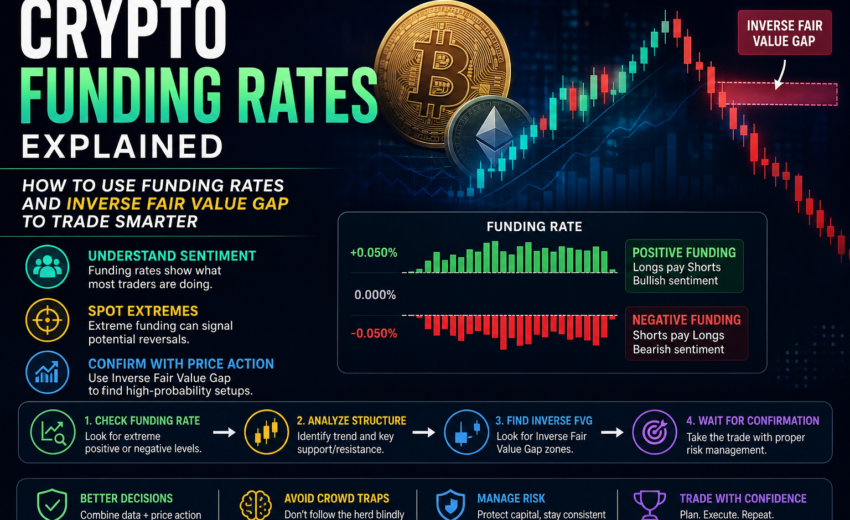
If you trade crypto futures, you have probably seen something called funding rates. At first, it looks like just another number. But in reality, it tells a deeper story about the market. I remember when I first noticed funding rates. I ignored them. Later, I realized they often reveal where the crowd is leaning. In this guide, I will explain Crypto Funding Rates in simple terms. More importantly, I will show you how to actually use them in trading. We will also connect this concept with the inverse fair value gap, which can sharpen your entries.
What Are Crypto Funding Rates?
Crypto funding rates are small payments exchanged between traders in perpetual futures contracts.
Unlike traditional futures, perpetual contracts do not expire. So exchanges use funding rates to keep the price of futures close to the spot market.
Here is the idea:
- If too many traders are buying (long positions), the funding rate becomes positive
- If too many traders are selling (short positions), the funding rate becomes negative
This creates balance.
How Funding Rates Work
Let’s break it down step by step.
1. Longs vs Shorts
- Long traders bet that price will go up
- Short traders expect price to fall
2. Positive Funding Rate
- Long traders pay short traders
- This usually means the market is bullish but crowded
3. Negative Funding Rate
- Short traders pay long traders
- This often shows bearish sentiment
4. Payment Timing
Funding is usually paid every 8 hours on most exchanges.
So if you hold a position, you either pay or receive funding depending on market conditions.
Why Funding Rates Matter in Trading
Now this is where things get interesting.
Funding rates are not just fees. They reflect market sentiment.
1. Crowd Behavior
When funding is very high, it often means too many traders are on one side.
2. Potential Reversals
Extreme funding rates can signal that a move is getting exhausted.
3. Risk Awareness
If you are paying high funding, your trade becomes expensive over time.
In practice, smart traders do not follow funding blindly. They use it as a clue, not a signal.
How to Read Funding Rate Data
Most traders use dashboards and charts to track funding.
Here is how to interpret it:
High Positive Funding
- Market is heavily long
- Risk of a pullback increases
High Negative Funding
- Market is heavily short
- Possibility of a short squeeze
Neutral Funding
- Balanced market
- No strong bias
Simple Insight
Extreme values matter more than normal ones.
What is an Inverse Fair Value Gap
Now let’s connect funding rates with price action.
An inverse fair value gap (IFVG) forms when a normal gap fails and flips its role.
For example:
- A bullish gap breaks
- Price moves through it
- That same zone becomes resistance
This flip often signals a shift in momentum.
Why Combine This with Funding Rates?
Funding tells you what traders are doing
IFVG shows you what price is doing
When both align, your setup becomes stronger.
Trading Strategy Using Funding Rates
Let me share a simple approach that works in real conditions.
Step 1: Check Funding Rate
Look for extremes. Avoid normal levels.
Step 2: Identify Market Structure
Find trend direction and key zones.
Step 3: Look for Inverse Fair Value Gap
Wait for a clean IFVG near your level.
Step 4: Wait for Confirmation
This could be:
- Rejection candles
- Break of structure
- Momentum shift
Step 5: Execute the Trade
- Enter near confirmation
- Keep stop loss tight
- Aim for logical targets
Example Scenario
- Funding is highly positive
- Market looks overbought
- Price breaks a bullish FVG
- IFVG forms and acts as resistance
This can be a strong short setup.
Common Mistakes Traders Make
I have seen these mistakes many times.
1. Blindly Following Funding
Funding alone is not a signal.
2. Ignoring Price Action
Price always comes first.
3. Overleveraging
High leverage with funding costs can wipe accounts.
4. Trading Every Signal
Patience matters more than frequency.
Pro Tips from Real Trading Experience
Over time, a few things become clear:
- Funding works best at extremes
- Combine it with structure, not indicators alone
- Markets often trap the majority
- Simplicity beats complexity
One lesson stands out.
When everyone leans in one direction, the market often moves the other way.
FAQs About Crypto Funding Rates
1. What are crypto funding rates?
Funding rates are periodic payments between traders to keep futures prices aligned with the spot market.
2. How often are funding rates paid?
Most exchanges charge or pay funding every 8 hours.
3. What does negative funding mean?
It means short traders are paying long traders, showing bearish sentiment.
4. Can funding rates predict reversals?
They can hint at potential reversals, especially at extreme levels, but they are not guaranteed signals.
5. What is an inverse fair value gap?
It is a price zone that flips from support to resistance or vice versa after a gap fails.
6. Are funding rates useful for beginners?
Yes, but beginners should combine them with price action and risk management.
7. Can I rely only on funding rates?
No. Always use them alongside structure and confirmation.
Conclusion
Crypto funding rates give you a window into trader behavior. They show where the crowd stands.
However, they are not magic.
The real edge comes when you combine funding rates with price action tools like the inverse fair value gap.
If you stay patient and focus on quality setups, this combination can improve your trading decisions over time.
May 5, 2026
What Is an Order Block in Trading?
May 5, 2026

Crypto Fear and Greed Index Explained for Traders May 7, 2026
[…] crypto fear and greed index remains one of the most popular sentiment tools in the cryptocurrency market. It helps traders […]