

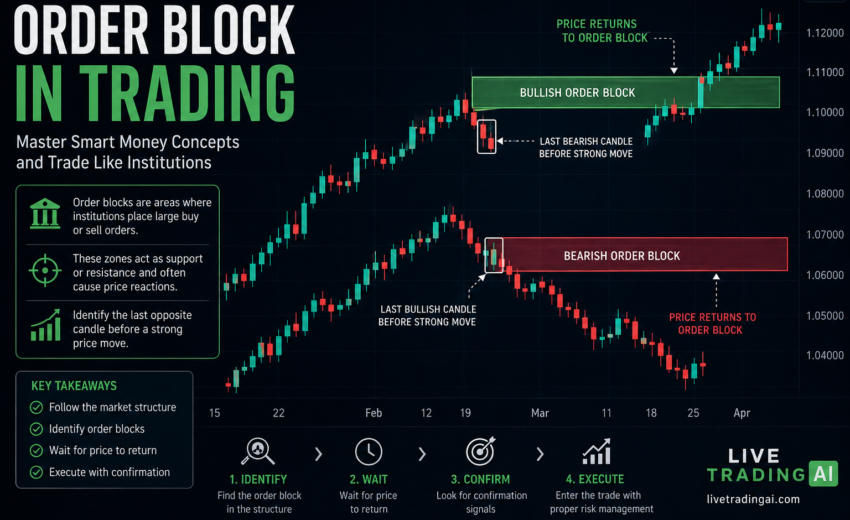
Many traders spend months trying to understand why the price suddenly reverses. They follow indicators, draw random lines, and still feel lost. If that sounds familiar, you are not alone. However, there is a smarter way to read the market. It focuses on how big players move prices rather than guessing. This is where the order block in trading comes into play.
In simple terms, order blocks help you spot where institutions have likely placed large trades. Once you understand this concept, charts start to make more sense.
What is an Order Block in Trading?
So, what is an order block in trading?
An order block is a price zone where large financial institutions, such as banks or hedge funds, place large buy or sell orders. These zones often lead to strong moves in the market.
Think of it like this. Imagine a supermarket where a bulk buyer places a huge order. That action affects supply and demand instantly. In trading, institutions do something similar. Their orders are so large that the price reacts sharply. Usually, an order block is the last opposite candle before a strong move. For example, before a strong rally, you may see a final bearish candle. That candle becomes a bullish order block.
How Order Blocks Work
Order blocks are not random. They form because institutions cannot enter trades simultaneously. Their positions are simply too large. Instead, they build positions over time. This creates a consolidation zone. After that, the price makes a strong move.
Later, the price often returns to that same zone. Why? Because unfilled orders are still sitting there. When the price comes back, those orders get triggered, and the market reacts again.
This is why order blocks often act like support and resistance, but with more meaning behind them.
Types of Order Blocks
Bullish Order Block
A bullish order block forms before a strong upward move. It is usually the last bearish candle before the price rises sharply.
When the price returns to this zone, traders look for buying opportunities.
Bearish Order Block
A bearish order block appears before a strong downward move. It is the last bullish candle before the price drops.
When price revisits this area, it may act as resistance.
How to Identify Order Blocks
Finding order blocks becomes easier with practice. Here are the key steps:
- Look for a consolidation phase
- Identify a strong breakout move
- Find the last opposite candle before the move
- Confirm a break in the structure
For example, if the price breaks a previous high and moves strongly upward, check the last bearish candle before that move. That is likely your order block.
How to Trade Using Order Blocks
Trading order blocks is simple when you follow a structured approach.
Entry
Wait for the price to return to the order block zone. Do not chase the market.
Confirmation
Look for signs such as rejection candles or shifts in market structure.
Stop Loss
Place your stop loss just beyond the order block zone.
Take Profit
Target the next key level or previous high/low.
Patience is important here. Many traders enter too early and get stopped out.
Common Mistakes Traders Make
Even though order blocks are powerful, mistakes can happen.
- Marking every zone as an order block
- Ignoring the overall market structure
- Trading without confirmation
- Using poor risk management
Because of this, it is important to stay disciplined and selective.
Pro Tips from Trading Experience
Many traders do not realise this at first, but context matters more than the zone itself.
For example, an order block in a strong trend is more reliable than one in a sideways market.
In addition, higher timeframes often provide stronger zones. A daily order block usually carries more weight than a 5-minute one.
Finally, always combine order blocks with structure. This small step can significantly improve your accuracy.
FAQs
What is an order block in trading?
It is a price zone where institutions place large buy or sell orders, often causing strong market moves.
Are order blocks reliable?
Yes, but only when used with proper market structure and confirmation.
How do beginners use order blocks?
Start by identifying strong moves and marking the last opposite candle. Then wait for the price to return.
Do order blocks work in crypto trading?
Yes, they work in crypto, forex, and stocks because institutional behaviour is similar across markets.
What timeframe is best for order blocks?
Higher timeframes, such as 1H, 4H, and daily, tend to be more reliable.
Conclusion
Understanding order block in trading can change how you see the market. Instead of guessing, you start to follow the footprints of smart money.
At first, it may feel confusing. However, with practice, it becomes clearer. Focus on structure, stay patient, and keep learning.
Over time, you will notice that the price is not random. It moves with purpose.

May 1, 2026
ICT Smart Money Concepts Explained Simply

May 1, 2026

Crypto Funding Rates Trading Guide May 5, 2026
[…] The real edge comes when you combine funding rates with price action tools like the inverse fair value gap. […]
arderborelnot August 2, 2026
Great post, I believe blog owners should larn a lot from this web blog its real user genial.