

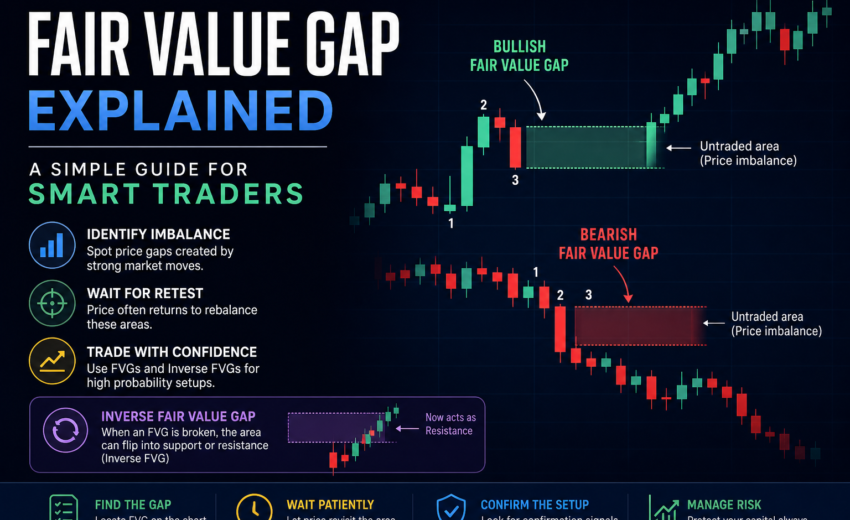
If you have spent time looking at price charts, you may have noticed that prices do not always move smoothly. Sometimes it jumps quickly and leaves empty zones behind. These areas are known as Fair Value Gap (FVGs). Now here is the interesting part. Many experienced traders do not ignore these gaps. Instead, they treat them as opportunities.
In this guide, I will explain what a Fair Value Gap is, how it works, and how you can actually use it in your trading. I will also break down the concept of the inverse fair value gap, which many beginners overlook.
What is a Fair Value Gap (FVG)?
A Fair Value Gap is a price imbalance that forms when the market moves quickly in one direction.
It usually appears in a three-candle pattern:
- The first candle starts the move
- The second candle is strong and impulsive
- The third candle continues the move
Because the move is so fast, the market leaves a gap between the first and third candles. This gap shows that the price did not trade fairly in that zone.
In simple words, the market skipped prices.
Traders believe that price often comes back to these areas later to “rebalance” before continuing.
How to Identify a Fair Value Gap
You do not need complicated tools to spot an FVG. You just need to train your eye.
Here is a simple way:
Bullish Fair Value Gap
- Price moves strongly upward
- Look at the gap between the low of the third candle and the high of the first candle
- If there is space between them, that is your gap
Bearish Fair Value Gap
- Price drops aggressively
- Look at the gap between the high of the third candle and the low of the first candle
Quick Tip
The stronger the move, the more meaningful the gap tends to be.
Why Fair Value Gaps Matter in Trading
This is where things get practical.
Markets move because of orders, especially large institutional orders. When institutions enter the market, they often make strong moves. These moves leave behind imbalances.
Price tends to return to these zones because:
- The market seeks efficiency
- Unfilled orders may still exist
- Liquidity needs to be balanced
That is why many traders wait for the price to revisit an FVG before taking trades.
What is an Inverse Fair Value Gap?
An inverse fair value gap (IFVG) is slightly different, but very powerful.
It forms when a normal FVG fails.
Let me explain simply:
- Price creates a Fair Value Gap
- Instead of respecting it, Price breaks through it
- The same zone now flips its role
So what was once a support area can become resistance, or vice versa.
This is called an inverse FVG.
Why it matters
Inverse gaps often act as strong confirmation zones. They show that the market has changed direction or momentum.
FVG vs Inverse FVG (Key Differences)
Here is a simple comparison:
Fair Value Gap
- Created by an imbalance
- Price often returns to fill it
- Used for retracement entries
Inverse Fair Value Gap
- Forms after FVG failure
- Acts like support or resistance
- Used for continuation trades
How to Trade Fair Value Gaps
Let’s keep this practical and simple.
Step 1: Identify the Trend
Always trade with the overall direction. This increases your chances.
Step 2: Mark the FVG
Find a clear gap after a strong move.
Step 3: Wait for Price to Return
Do not chase the market. Let the price re-enter the gap.
Step 4: Look for Confirmation
This could be:
- Rejection candles
- Break of structure
- Strong reaction
Step 5: Enter the Trade
- Enter near the gap
- Place a stop loss just outside the gap
- Target recent highs or lows
Risk Tip
Never risk too much on a single trade. Even the best setups fail.
Common Mistakes Traders Make
Many beginners struggle with FVGs because of simple mistakes.
1. Trading Every Gap
Not all gaps are important. Focus on strong moves only.
2. Ignoring Market Trend
A good setup against the trend often fails.
3. No Confirmation
Entering blindly can lead to losses.
4. Poor Risk Management
Even a good idea can fail without discipline.
Pro Tips from Experience
After working with price action for a long time, here are a few things that stand out:
- Clean charts work better than cluttered ones
- Higher timeframes give stronger signals
- Not every gap will fill, and that is normal
- Patience matters more than precision
One thing many traders learn the hard way is this:
Waiting for the right setup is more profitable than forcing trades.
FAQs About Fair Value Gap
1. What is a Fair Value Gap in trading?
A Fair Value Gap is an area where the price moved quickly and left an imbalance between candles.
2. Does price always fill a Fair Value Gap?
No. Price often returns, but not always. That is why confirmation is important.
3. What is an inverse fair value gap?
It is a failed FVG that flips into a support or resistance zone.
4. Are FVGs good for beginners?
Yes, but only if combined with proper risk management and trend analysis.
5. Which timeframe works best for FVG?
Higher timeframes like 1H, 4H, and Daily usually provide more reliable setups.
6. Can I use FVG in forex and crypto?
Yes. The concept works in all markets because it is based on price behavior.
7. Is FVG part of Smart Money Concepts?
Yes. It is widely used in smart money and institutional trading strategies.
Conclusion
Fair Value Gap is not just a random space on a chart. They reflect how the market actually moves.
Once you understand them, you start to see price differently.
At the same time, do not rely on FVG alone. Combine it with trend, structure, and discipline. That is what separates consistent traders from beginners.
If you stay patient and practice regularly, this concept can become a valuable part of your trading toolkit.

March 5, 2026



arderbor elnot August 4, 2026
Valuable information. Lucky me I found your site by accident, and I am shocked why this accident did not happened earlier! I bookmarked it.